portugal_text_find_icon

Using proxy servers is not required for this task.
The request must contain a single image in base64 format, consisting of 5 horizontally merged images (without text) arranged in the order of their display. A detailed example of the stitching process is shown below. Additionally, the TaskArgument parameter specifies the task text — the target icon to find.
Request parameters
IMPORTANT: obtain the base64 image directly before creating the task to avoid errors during solving (see section Automated recognition and solving examples).
type<string>requiredComplexImageTask
class<string>requiredrecognition
imagesBase64<array>requiredBase64-encoded image (wrapped in an array, without the data:image/png;base64, prefix).
Task (inside metadata)<string>requiredTask name: "portugal_text_find_icon"
TaskArgument (inside metadata)<string>requiredTask text that defines which icon must be found. Example: "Clique no(a) quadrado."
Important: some characters in the task text must be properly escaped to avoid processing or solving errors.
For example, for the text "Por favor, clique no(a) avião." you must pass "Por favor, clique no(a) avi\\u00E3o."
(see example in section Automated recognition and solving examples).
Create task method
https://api.capmonster.cloud/createTask
Request example
{
  "clientKey": "API_KEY",
  "task": {
    "type": "ComplexImageTask",
    "class": "recognition",
    "imagesBase64": [
      "iVBORw0KGgoAAAA...SuQmCC"
    ],
    "metadata": {
      "Task": "portugal_text_find_icon",
      "TaskArgument": "Encontre o(a) avi\\u00E3o."
    }
  }
}
Response example
{
  "errorId":0,
  "taskId":143998457
}
Example task:
The example shows 5 icons and the task text: "Encontre o(a) avião." (Find the airplane).
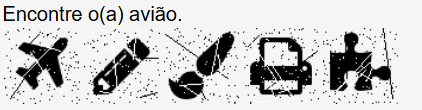
You must send an image in base64 format that represents 5 horizontally merged icon images:

Get task result method
https://api.capmonster.cloud/getTaskResult
Request example
{
  "clientKey":"API_KEY",
  "taskId": 143998457
}
Response example:
The returned index is the number of the icon that must be clicked. Icon indexing starts from 1 and ends at 5:
{
  "solution": {
    "answer": [4],
    "metadata": {
      "AnswerType": "NumericArray"
    }
  },
  "status": "ready",
  "errorId": 0,
  "errorCode": null,
  "errorDescription": null
}
Automated recognition and solving examples
Examples in Python using Requests and Playwright, demonstrating the full captcha workflow: from retrieving the task and extracting images to processing, preparing, and sending them to CapMonster Cloud for recognition, as well as obtaining the final result.
These examples are for demonstration purposes and illustrate the general logic of working with your website. In real projects, the code may require adaptation to a specific site, its requests, and headers.
Sensitive data (API keys, proxy settings, etc.) should be stored in .env files or environment variables.
- Using requests
- Using Playwright
Show code
import os
import io
import time
import base64
import csv
import json
import re
import requests
from PIL import Image

# ===================== CONFIGURATION =====================
# It is recommended to store sensitive data in .env

# Base URL of internal captcha API
BASE = "https://www.example.com"

# CapMonster Cloud API
API_KEY = "YOUR_API_KEY"
CREATE_TASK_URL = "https://api.capmonster.cloud/createTask"
GET_RESULT_URL = "https://api.capmonster.cloud/getTaskResult"

# Headers to simulate a real browser request
HEADERS = {
    "User-Agent": "userAgentPlaceholder",
    "Referer": BASE + "/",
    "Accept": "image/avif,image/webp,image/apng,image/*,*/*;q=0.8",
    "Connection": "keep-alive"
}

# Directory for saving data (images, logs, CSV)
SAVE_DIR = "captcha_results"
os.makedirs(SAVE_DIR, exist_ok=True)

session = requests.Session()
session.headers.update(HEADERS)

# ===================== UTILITIES =====================

def serialize_json(text):
    """
    Converts a string into a JSON-safe format.
    """
    json_str = json.dumps(text, ensure_ascii=True)[1:-1]
    return re.sub(r'\\u([0-9a-f]{4})', lambda m: '\\u' + m.group(1).upper(), json_str)


def post_json(url, payload):
    """
    Sends a POST request with a JSON body and returns the server response.
    """
    return requests.post(url, json=payload).json()

# ===================== CAPTCHA FETCHING =====================

def get_captcha():
    """
    Requests a new captcha from the site internal API.
    """
    url = f"{BASE}/api.php?action=new"
    res = session.get(url)
    data = res.json()
    print("[CAPTCHA]:", data)
    return data


def build_image_urls(data):
    """
    Builds a list of captcha image URLs based on session and answers.
    """
    return [
        f"{BASE}/api.php?action=img&s={data['session']}&c={ans}"
        for ans in data["answers"]
    ]

# ===================== IMAGE PROCESSING =====================

def download_images(urls):
    """
    Downloads captcha images from a list of URLs.
    """
    images = []
    for url in urls:
        r = session.get(url)

        if "image" not in r.headers.get("Content-Type", ""):
            continue

        if len(r.content) < 100:
            continue

        try:
            img = Image.open(io.BytesIO(r.content)).convert("RGBA")
            images.append(img)
        except:
            pass

    return images


def merge_images(pil_images):
    """
    Merges multiple images into one (horizontal concatenation).
    """
    widths, heights = zip(*(img.size for img in pil_images))

    result = Image.new("RGBA", (sum(widths), max(heights)))

    x = 0
    for img in pil_images:
        result.paste(img, (x, 0))
        x += img.size[0]

    return result


def to_base64(img):
    """
    Converts an image to a base64 string.
    """
    buf = io.BytesIO()
    img.save(buf, format="PNG")
    return base64.b64encode(buf.getvalue()).decode()


def save_csv(prompt, urls):
    """
    Saves captcha log (prompt + image URLs) into a CSV file.
    """
    with open(os.path.join(SAVE_DIR, "captcha.csv"), "w", newline="", encoding="utf-8") as f:
        writer = csv.writer(f)
        writer.writerow(["prompt", "image_url"])
        for url in urls:
            writer.writerow([prompt, url])

# ===================== CAPMONSTER CLOUD API =====================

def create_task(base64_image, prompt):
    """
    Creates a CapMonster Cloud task for image recognition.
    """
    payload = {
        "clientKey": API_KEY,
        "task": {
            "type": "ComplexImageTask",
            "class": "recognition",
            "imagesBase64": [base64_image],
            "metadata": {
                "Task": "portugal_text_find_icon",
                "TaskArgument": serialize_json(prompt)
            }
        }
    }

    res = post_json(CREATE_TASK_URL, payload)
    print("[createTask]:", res)
    return res.get("taskId")


def get_result(task_id):
    """
    Waits for task completion and returns the result.
    """
    while True:
        time.sleep(2)

        res = post_json(GET_RESULT_URL, {
            "clientKey": API_KEY,
            "taskId": task_id
        })

        if res.get("status") == "ready":
            return res

        print("[...] waiting for result...")

# ===================== MAIN PROCESS =====================

def main():

    # fetch captcha
    data = get_captcha()
    prompt = data["question_i"]
    print("[PROMPT]:", prompt)

    # build image URLs
    urls = build_image_urls(data)
    save_csv(prompt, urls)

    # download images
    images = download_images(urls)
    if not images:
        print("No images found")
        return

    # merge images into one
    merged = merge_images(images)

    filepath = os.path.join(SAVE_DIR, f"captcha_{int(time.time())}.png")
    merged.save(filepath)
    print("[+] Saved image:", filepath)

    # convert image to base64
    base64_img = to_base64(merged)

    # create task in CapMonster Cloud
    task_id = create_task(base64_img, prompt)
    if not task_id:
        print("createTask error")
        return

    print("[+] taskId:", task_id)

    # get result
    result = get_result(task_id)

    print("\n=== FULL RESULT ===")
    print(json.dumps(result, indent=2, ensure_ascii=False))


if __name__ == "__main__":
    main()
Show code
import os
import io
import time
import base64
import json
import requests
import re
from playwright.sync_api import sync_playwright
from PIL import Image

# API key for CapMonster Cloud
API_KEY = "YOUR_API_KEY"

# CapMonster Cloud endpoints
CREATE_TASK_URL = "https://api.capmonster.cloud/createTask"
GET_RESULT_URL = "https://api.capmonster.cloud/getTaskResult"

# Target site with captcha
TARGET_URL = "https://www.example.com"

# Directory for saving final captcha image
SAVE_DIR = "captcha_imgs"
os.makedirs(SAVE_DIR, exist_ok=True)

# Browser User-Agent to simulate a real user
USER_AGENT = "userAgentPlaceholder"


def serialize_json(text):
    # Converts text into a JSON-safe string with Unicode escaping
    json_str = json.dumps(text, ensure_ascii=True)[1:-1]

    # Convert Unicode symbols to uppercase (required by some captcha tasks)
    return re.sub(r'\\u([0-9a-f]{4})',
                  lambda m: '\\u' + m.group(1).upper(),
                  json_str)


# Merges multiple images into one horizontal image
def merge_images(images):

    widths, heights = zip(*(img.size for img in images))

    result = Image.new("RGBA", (sum(widths), max(heights)), (0, 0, 0, 0))

    x_offset = 0
    for img in images:
        if img.mode != "RGBA":
            img = img.convert("RGBA")

        # Place images side by side (in a row)
        result.paste(img, (x_offset, 0), img)
        x_offset += img.size[0]

    return result


# Converts PIL image to base64 string
def image_to_base64(img):
    buffer = io.BytesIO()
    img.save(buffer, format="PNG")
    return base64.b64encode(buffer.getvalue()).decode()


def post_json(url, payload):
    return requests.post(url, json=payload).json()


# Loads image from URL or decodes base64
def fetch_image(session, src):
    # If image is provided as base64 (data URI)
    if src.startswith("data:"):
        return base64.b64decode(src.split(",", 1)[1])

    # Otherwise download from URL
    res = session.get(src, headers={
        "User-Agent": USER_AGENT,
        "Referer": TARGET_URL
    })

    # Check successful response
    if res.status_code != 200:
        raise Exception(f"Error loading image: {src}")

    return res.content


# Creates captcha solving task
def create_task(base64_image, prompt):
    payload = {
        "clientKey": API_KEY,
        "task": {
            "type": "ComplexImageTask",
            "class": "recognition",
            "imagesBase64": [base64_image],
            "metadata": {
                "Task": "portugal_text_find_icon",
                "TaskArgument": serialize_json(prompt)  # captcha instruction
            }
        }
    }

    print("\n[=== createTask ===]")
    print(json.dumps(payload, indent=2))

    res = post_json(CREATE_TASK_URL, payload)
    print("[createTask]:", res)

    return res.get("taskId")


# Waits for captcha solution result
def get_result(task_id):
    while True:
        time.sleep(2)  # request delay

        res = post_json(GET_RESULT_URL, {
            "clientKey": API_KEY,
            "taskId": task_id
        })

        # If solution is ready
        if res.get("status") == "ready":
            return res.get("solution")

        print("[...] waiting for result...")


def main():
    session = requests.Session()

    images_data = []

    with sync_playwright() as p:
        # Launch browser (non-headless for debugging)
        browser = p.chromium.launch(headless=False)
        page = browser.new_page()

        # Open target page
        page.goto(TARGET_URL)

        # Wait for captcha instruction text
        page.wait_for_selector(".captcheck_question_image", timeout=15000)
        prompt = page.locator(".captcheck_question_image").first.inner_text()
        print("[PROMPT]:", prompt)

        # Find all captcha answer images
        answer_links = page.locator(".captcheck_answer_images a")
        count = answer_links.count()

        print(f"[+] Found images: {count}")

        # Extract image sources
        for i in range(count):
            img = answer_links.nth(i).locator("img")
            src = img.get_attribute("src")

            # Download image
            images_data.append(fetch_image(session, src))

        browser.close()

    print(f"[+] Received images: {len(images_data)}")

    # If no images found, exit
    if not images_data:
        print("No images found")
        return

    # Convert bytes to PIL images
    images = [Image.open(io.BytesIO(x)) for x in images_data]

    # Merge images
    merged = merge_images(images)

    # Save final image
    path = f"{SAVE_DIR}/result.png"
    merged.save(path)
    print("[+] Saved:", path)

    # Convert image to base64
    base64_image = image_to_base64(merged)

    print("[+] Sending to CapMonster Cloud...")
    task_id = create_task(base64_image, prompt)

    # Check task creation
    if not task_id:
        print("createTask error")
        return

    print("[+] taskId:", task_id)

    # Wait for result
    solution = get_result(task_id)

    print("\nRESULT:")
    print(solution)


if __name__ == "__main__":
    main()
Use the SDK library
- JavaScript / TypeScript
- Python
- C#
Show code (for browser)
// https://github.com/CapMonsterCloud/capmonster-nodejs-captcha-solver

import {
  CapMonsterCloudClientFactory,
  ClientOptions,
  ComplexImageTaskRecognitionRequest
} from "@zennolab_com/capmonstercloud-client";

document.addEventListener("DOMContentLoaded", async () => {

  const API_KEY = "YOUR_API_KEY"; // Specify your CapMonster Cloud API key

  const client = CapMonsterCloudClientFactory.Create(
    new ClientOptions({ clientKey: API_KEY })
  );

  // Proxies are not required for ComplexImageTaskRecognitionRequest
  const portugalTextFindIconRequest = new ComplexImageTaskRecognitionRequest({
    imagesBase64: ["your_image_base64"],
    metaData: {
      Task: "portugal_text_find_icon",
      TaskArgument: "Encontre o(a) avi\u00E3o.",
    },
  });

  // You can check your balance if necessary
  const balance = await client.getBalance();
  console.log("Balance:", balance);

  const result = await client.Solve(portugalTextFindIconRequest);
  console.log("Solution:", result.solution);
});
Show code (Node.js)
// https://github.com/CapMonsterCloud/capmonster-nodejs-captcha-solver

const {
  CapMonsterCloudClientFactory,
  ClientOptions,
  ComplexImageTaskRecognitionRequest,
} = require("@zennolab_com/capmonstercloud-client");

const API_KEY = "YOUR_API_KEY"; // Specify your CapMonster Cloud API key

async function solvePortugalTextFindIcon() {
  const client = CapMonsterCloudClientFactory.Create(
    new ClientOptions({ clientKey: API_KEY }),
  );

  // Proxies are not required for ComplexImageTaskRecognitionRequest
  const portugalTextFindIconRequest = new ComplexImageTaskRecognitionRequest({
    imagesBase64: ["your_image_base64"],
    metaData: {
      Task: "portugal_text_find_icon",
      TaskArgument: "Encontre o(a) avi\u00E3o.",
    },
  });

  // You can check your balance if necessary
  const balance = await client.getBalance();
  console.log("Balance:", balance);

  const result = await client.Solve(portugalTextFindIconRequest);
  console.log("Solution:", result.solution);
}

solvePortugalTextFindIcon().catch(console.error);
Show code
# https://github.com/CapMonsterCloud/capmonster-python-captcha-solver

import asyncio

from capmonstercloudclient import CapMonsterClient, ClientOptions
from capmonstercloudclient.requests import RecognitionComplexImageTaskRequest

API_KEY = "YOUR_API_KEY"  # Specify your CapMonster Cloud API key


async def solve_portugal_text_find_icon():
    client = CapMonsterClient(
        options=ClientOptions(api_key=API_KEY)
    )

    # Proxies are not required for RecognitionComplexImageTaskRequest
    portugal_text_find_icon_request = RecognitionComplexImageTaskRequest(
        imagesBase64=[
            "your_image_base64",
        ],
        metadata={
            "Task": "portugal_text_find_icon",
            "TaskArgument": "Encontre o(a) avi\\u00E3o.",
        },
    )

    # You can check your balance if necessary
    balance = await client.get_balance()
    print("Balance:", balance)

    result = await client.solve_captcha(portugal_text_find_icon_request)
    print("Solution:", result)


asyncio.run(solve_portugal_text_find_icon())
Show code
// https://github.com/CapMonsterCloud/capmonster-dotnet-captcha-solver

using System;
using System.Threading.Tasks;
using Newtonsoft.Json;
using Zennolab.CapMonsterCloud;
using Zennolab.CapMonsterCloud.Requests;

class Program
{
    static async Task Main(string[] args)
    {
        const string API_KEY = "YOUR_API_KEY"; // Specify your CapMonster Cloud API key

        var clientOptions = new ClientOptions
        {
            ClientKey = API_KEY
        };

        var cmCloudClient = CapMonsterCloudClientFactory.Create(clientOptions);

        // Proxies are not required for RecognitionComplexImageTaskRequest
        var portugalTextFindIconRequest = new RecognitionComplexImageTaskRequest
        {
            ImagesBase64 = new[]
            {
                "your_image_base64"
            },

            Metadata = new RecognitionComplexImageTaskRequest.RecognitionMetadata
            {
                Task = "portugal_text_find_icon",
                TaskArgument = "Encontre o(a) avi\u00E3o."
            }
        };

        // You can check your balance if necessary
        var balance = await cmCloudClient.GetBalanceAsync();
        Console.WriteLine("Balance: " + balance);

        var result = await cmCloudClient.SolveAsync(portugalTextFindIconRequest);

        Console.WriteLine("Solution:");
        Console.WriteLine(
            JsonConvert.SerializeObject(
                result.Solution,
                Formatting.Indented
            )
        );
    }
}